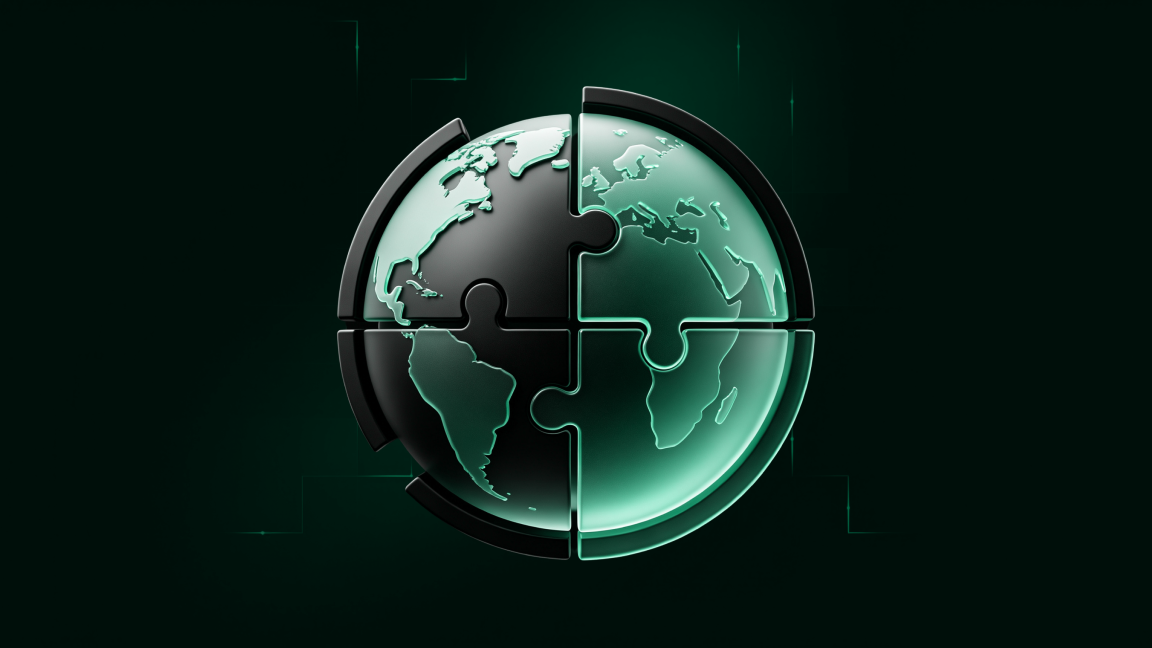
Investing has gone global. Brokerage infrastructure hasn't.
An investor in Southeast Asia might follow NVIDIA in the U.S., Tencent in Hong Kong, and SK hynix in Korea — all from the same phone, often in the same hour.
Information moves globally. Capital increasingly does too.
But actually investing across those markets can still feel surprisingly local.
Different brokerage accounts. Different funding methods. Different currencies. Different trading hours. Different settlement systems.
The problem isn't that global markets don't exist.
It's that the infrastructure used to access them was built for a more local world.
Brokerage Inherited the Banking System
Traditional brokerage was built around a simple assumption: investors fund their accounts through the local banking system.
That works well when the investor, bank, broker, currency, and stock market are all in the same place.
It becomes more complicated when they aren't.
An investor trying to access an overseas market may need to move money through several layers:
Local bank → FX conversion → cross-border transfer → brokerage account → stock market
Each layer can introduce additional time, cost, and operational complexity.
And adding another market doesn't necessarily mean adding another stock ticker. It can mean adding another currency, another settlement system, another custody arrangement, and another set of market rules.
More Markets Doesn't Always Mean Global Access
Brokerages have expanded internationally for years.
Many now offer access to thousands of securities across multiple exchanges.
But the experience can still be fragmented underneath.
The U.S. equity market generally operates on T+1 settlement. Hong Kong and Korea currently operate on T+2 settlement cycles.
Trading calendars are different. Market hours are different. Currencies are different.
Even when all three markets appear inside one interface, connecting the investor's capital to those markets remains an infrastructure problem.
That distinction matters.
A global stock list is not necessarily a global brokerage experience.
Stablecoins Change the Funding Layer
Stablecoins introduce a different starting point.
Instead of beginning with a local bank account and asking how money can be moved into another country's financial system, the investor can begin with a digital dollar that already moves across borders and operates around the clock.
USDT and USDC don't make stock exchanges global.
They don't replace clearing houses, custodians, brokers, or regulated market infrastructure.
What they can change is the funding layer connecting investors to that infrastructure.
The model becomes simpler:
Stablecoins → Brokerage → Global Markets
That is a much bigger idea than simply “buying stocks with crypto.”
The opportunity is to use a global funding rail while keeping the underlying securities connected to the financial infrastructure where those assets actually trade, clear, and settle.
Real Markets Still Matter
Making the funding layer more global doesn't mean replacing traditional market infrastructure.
In many ways, the opposite is true.
A share of NVIDIA still needs to trade in the U.S. market. A share of SK hynix still belongs within Korea's securities infrastructure. Different markets continue to have their own trading sessions, holidays, settlement cycles, custody systems, and regulations.
The challenge is therefore not to rebuild every stock market onchain.
It is to connect a new global funding layer with the existing infrastructure that already supports real securities.
This distinction is important.
The goal isn't to make global equities behave like crypto assets.
It's to make accessing global equities feel less fragmented.
One Funding Rail, Multiple Markets
This is the direction we're building toward at StableStock.
StableStock currently connects stablecoin funding with access to real equities across the U.S., Hong Kong, and Korea.
Instead of maintaining a separate funding relationship for every market, users can fund with USDT or USDC and access multiple equity markets through one account.
Behind that experience, the markets remain different.
They still have different currencies, trading hours, settlement cycles, clearing processes, and custody infrastructure.
The complexity doesn't disappear.
The goal is to move more of that complexity away from the investor.
One account. One funding rail. Multiple equity markets.
The Next Brokerage Account Should Start Global
The internet made information global.
Stablecoins made money global.
Brokerage infrastructure is beginning to catch up.
The brokerage account of the past was built around where an investor banked.
The brokerage account of the future may be built around what an investor wants to own.
That means thinking beyond a single local bank, a single currency, or even a single stock market.
Global investing shouldn't require investors to rebuild their financial setup every time they cross a market boundary.
The markets can remain local.
The access layer doesn't have to be.
StableStock provides stablecoin-funded access to real global equities through licensed financial institutions responsible for execution, clearing, and custody.
For informational purposes only. Not an offer, solicitation, or investment advice. Product availability and market access vary by jurisdiction. Services are not available to U.S. persons or residents of restricted jurisdictions (including Hong Kong).